 Free Shipping
  Buy Now, Pay Later
  Eligible

Does Red Light Therapy Help with Polymyositis? A Professional Analysis of the Evidence
Bottom line: Red light therapy (photobiomodulation) is not a treatment for polymyositis itself, but emerging evidence suggests it may serve as a supportive adjunct for managing localized muscle pain and promoting tissue recovery. The therapy cannot penetrate deep enough to reach the primary sites of autoimmune muscle inflammation in the trunk and proximal muscles, and it does not modify the underlying disease process. Current standard of care remains immunosuppressive medication and physical therapy.
Understanding Polymyositis
Polymyositis is a rare autoimmune inflammatory myopathy in which the immune system mistakenly attacks skeletal muscle tissue, causing weakness that most often affects the muscles closest to the trunk—hips, thighs, shoulders, upper arms, and neck . The condition typically affects adults in their 40s to 60s, and women more often than men .
Standard treatments focus on suppressing the overactive immune response:
There is no cure for polymyositis, and treatment focuses on controlling inflammation, preserving muscle function, and preventing complications such as swallowing difficulties, breathing problems, and interstitial lung disease .
What Is Red Light Therapy (Photobiomodulation)?
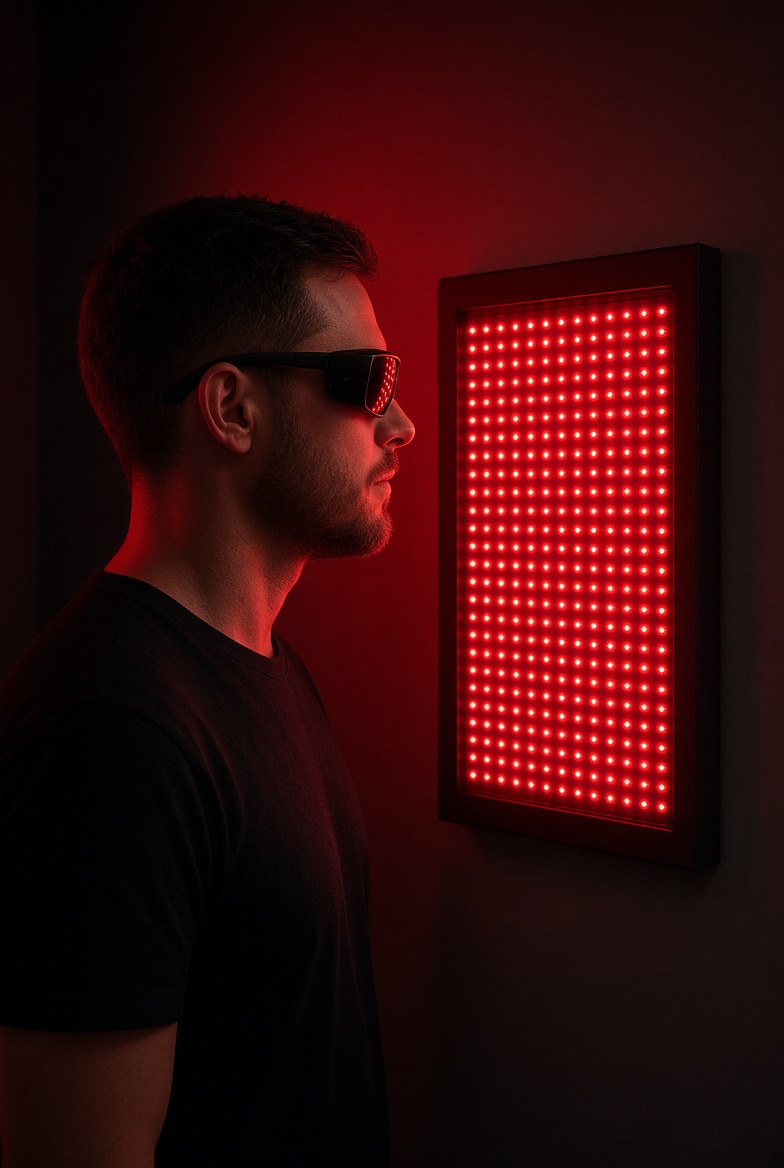
Photobiomodulation (PBM), commonly called red light therapy or low-level laser therapy, uses non-thermal red and near-infrared wavelengths (typically 600–1100 nm) to influence cellular activity . The proposed mechanisms include:
- Mitochondrial stimulation: Photons are absorbed by cytochrome c oxidase, enhancing ATP production and cellular energy
- Anti-inflammatory effects: Suppression of pro-inflammatory cytokines (IL-1β, IL-6, TNF-α) and modulation of the NF-κB pathway
- Pain modulation: Inhibition of pain signal transmission and increased release of endogenous opioids
However, a critical limitation for polymyositis is tissue penetration. Red light at 630–700 nm penetrates only superficially. Near-infrared wavelengths (810–850 nm) reach deeper into subcutaneous tissue and skeletal muscle, but the deeply situated proximal muscles most affected in polymyositis—hip flexors, quadriceps, shoulder girdle—remain challenging to target adequately .
Evidence for Red Light Therapy in Myositis and Related Conditions
What the Research Shows
Case reports in polymyositis/dermatomyositis (2021): A Japanese case series described two patients with polymyositis-dermatomyositis whose refractory muscle pain was successfully managed with linear polarized near-infrared irradiation near the stellate ganglion plus xenon light therapy. Both patients experienced significant pain reduction (one from NRS 8/10 to 0/10 over six weeks) alongside conventional immunosuppressive therapy . These are uncontrolled case reports, but they suggest a potential analgesic role for photobiomodulation in inflammatory myopathies.
Systematic reviews in inflammatory conditions: A 2019 review in Current Allergy and Asthma Reports summarized the field of low-level laser therapy for inflammatory, musculoskeletal, and autoimmune disease, noting variability in treatment protocols but acknowledging potential for future investigation .
Muscle recovery evidence: A 2015 meta-analysis of 46 RCTs found that photobiomodulation applied before exercise reduced markers of muscle damage (creatine kinase) and delayed-onset muscle soreness . While this does not directly translate to autoimmune myositis, it supports the biological plausibility of PBM affecting skeletal muscle recovery.
Critical Limitations for Polymyositis
As one clinician noted in a Mayo Clinic Connect discussion, several rheumatologists and dermatologists have told patients that red light “won’t work since red light can’t penetrate deep enough through muscle tissue” .
Comparison: Standard Treatments vs. Red Light Therapy for Polymyositis
Clinical Bottom Line: Where Red Light Therapy Fits
Red light therapy is not a treatment for polymyositis itself. The disease is driven by systemic autoimmune attack on muscle tissue, and local light application cannot address this root cause. The proximal muscles most affected by polymyositis—hips, thighs, shoulders—are also the least accessible to photobiomodulation due to tissue depth.
However, red light therapy may have a narrow supportive role in a comprehensive treatment plan. The case reports from Japan suggest that localized PBM could help manage refractory muscle pain in patients already on appropriate immunosuppressive therapy. This aligns with the broader principle that PBM is “helpful, but not a cure” for autoimmune inflammatory pain syndromes—it can address secondary soft tissue pain and compensatory muscle tension without modifying the underlying disease .
What red light therapy cannot do:
- Replace corticosteroids, immunosuppressants, or IVIG
- Suppress systemic autoimmune inflammation
- Reverse muscle weakness caused by active myositis
- Reach deep proximal muscles where polymyositis primarily manifests
What red light therapy might do (as an adjunct):
- Provide localized pain relief for accessible muscle groups
- Support recovery from exercise or physical therapy-related soreness
- Offer a low-risk complementary option for patients with concurrent localized musculoskeletal pain
The decision to use red light therapy should be made in consultation with your rheumatologist, ensuring it does not delay or replace evidence-based immunosuppressive treatment. Patients should maintain realistic expectations: this is a comfort measure at best, not a disease-modifying intervention.
Frequently Asked Questions
Can red light therapy replace prednisone or other medications for polymyositis?
No. Photobiomodulation cannot suppress the systemic autoimmune response that drives polymyositis. Discontinuing or reducing immunosuppressive therapy in favor of red light therapy risks irreversible muscle damage and disease progression .
Has red light therapy been studied specifically in polymyositis?
Only in isolated case reports, not controlled trials. The two published cases involved polymyositis-dermatomyositis patients whose pain was managed alongside conventional therapy . No randomized controlled trials have evaluated PBM as a primary treatment for polymyositis.
What wavelength is needed for muscle tissue?
Near-infrared wavelengths (810–850 nm) penetrate more deeply than visible red light (630–700 nm) and are more appropriate for musculoskeletal applications . However, even near-infrared light has limited reach into the deep proximal muscles affected in polymyositis.
Is red light therapy safe for people with autoimmune conditions?
Photobiomodulation has a strong safety profile with no known systemic immunosuppressive effects . The primary risk is financial cost and the potential for delaying proven treatments if used as a substitute for medical therapy.
Should I try red light therapy before or after exercise/physical therapy?
Evidence from sports medicine suggests pre-exercise application may best reduce muscle damage markers and soreness . Discuss timing with your rheumatologist and physical therapist.
This article is for educational purposes only and does not constitute medical advice. Individuals with polymyositis should consult their rheumatologist or healthcare provider before initiating any new therapy, including red light therapy.