 Free Shipping
  Buy Now, Pay Later
  Eligible

What Are the Hidden Efficiency Killers in Your Medical Practice?
It is not normally a single huge failure which causes a practice to grind to a halt. Rather, it is the quiet pile of efficiency killers—little things or processes that are often ignored, but that take time and energy. When you suspect that your clinic is bleeding time, the following are the most visible offenders.
Solving Software Fragmentation and Data Entry Fatigue
Technology was supposed to save us, right? However, in most clinics, the software stack has turned into a burden and not a helper. It is common to observe practices that are based on three or four platforms that do not communicate with each other. You may have a system to book, one to bill, and another one to take clinical notes.
Such fragmentation compels employees to enter information twice. It is a little thing—type a name here, type one there—but when you multiply that by thirty patients a day, you have lost hours. And to add to it, the error rate grows with each manual entry.
It does not always have to be about purchasing the most costly software available, but auditing what you already possess. Is your existing arrangement integrated? When your receptionist is forced to minimize three windows to inform a patient about their balance, then you have broken your workflow. An integrated patient management system works to fill these gaps so that by the time a patient is checked in, their billing and clinical files are there, waiting, without a digital scavenger hunt.
Optimizing Clinic Layout for Better Workflow
We devote so much time to streamlining digital processes that we overlook the physical environment. Have you ever followed the physical movements of your staff in a day?
Once I was in a clinic where the printer was in a back room, down a back hallway from the front desk. The reception staff were required to walk approximately 20 meters each time they needed to give a patient a referral or a receipt. A year of that is miles of walking and days of time wasted.
The other gigantic factor is clutter. I do not only mean untidy desks, but the overall cleanliness and order of the waiting and clinical rooms. An anarchic world produces anarchic minds. When a physician must find the otoscope because they did not put it back in the correct drawer, the consultation is prolonged. When the waiting room is dingy or dusty, patients become anxious, and this causes interactions to be longer and more challenging.
Deep cleaning of the physical space is another area worth outsourcing rather than having exhausted personnel clean surfaces at the end of a shift. The environment can be cleaned to perfection with the help of professional services. Entering the day in a clean and neat environment creates a subconscious standard of efficiency for the whole team.
Streamlining Internal Team Communication
How does your team communicate? Communication in most practices is a combination of sticky notes, shouting along the corridor, and instant messages that are ignored.
The big killer of productivity is the “quick question.” It takes an average of 15 minutes for a doctor to get back to deep focus when interrupted in the process of a consultation to respond to a query from the front desk. When that occurs four times in a day, the doctor has lost an hour of optimum cognitive performance.
The solution is to put in place organized communication channels. In place of random interruptions, use a morning huddle. A five to ten-minute discussion at the beginning of the shift regarding the schedule, possible bottlenecks (such as a complicated procedure slot), and staffing problems can save hours of confusion later. For any non-urgent questions, an internal messaging system should be used, with the understanding that it will be checked between patients rather than during them.
Implementing Smart Scheduling to Manage Patient Flow
Efficiency is not merely a question of the speed of your employees, but rather how efficiently you control the flow of people. The disconnect between the schedule and reality is one of the largest silent killers.
When you schedule 15 minutes per appointment, but you are aware that Mrs. Jones always needs 25 minutes due to her complicated needs, you are dooming your afternoon to failure even before it starts. At 2:00 PM, you are going to be 45 minutes late. This puts pressure on the staff, frustrates the patients in the waiting room (who will consume more time complaining to the receptionist), and rushes the doctor, resulting in substandard care.
You must adopt the concept of smart scheduling. This includes the analysis of appointment types and patient history. If you know a certain procedure lasts 20 minutes, do not schedule it in a 15-minute slot and expect a miracle. Build “catch-up blocks” into the day—possibly 10 minutes at two-hour intervals where there is no booking. This buffer enables the doctor to complete notes, make a call back, or simply take a breath to keep the remaining schedule on track.
Digitizing Patient Intake and Inventory Management
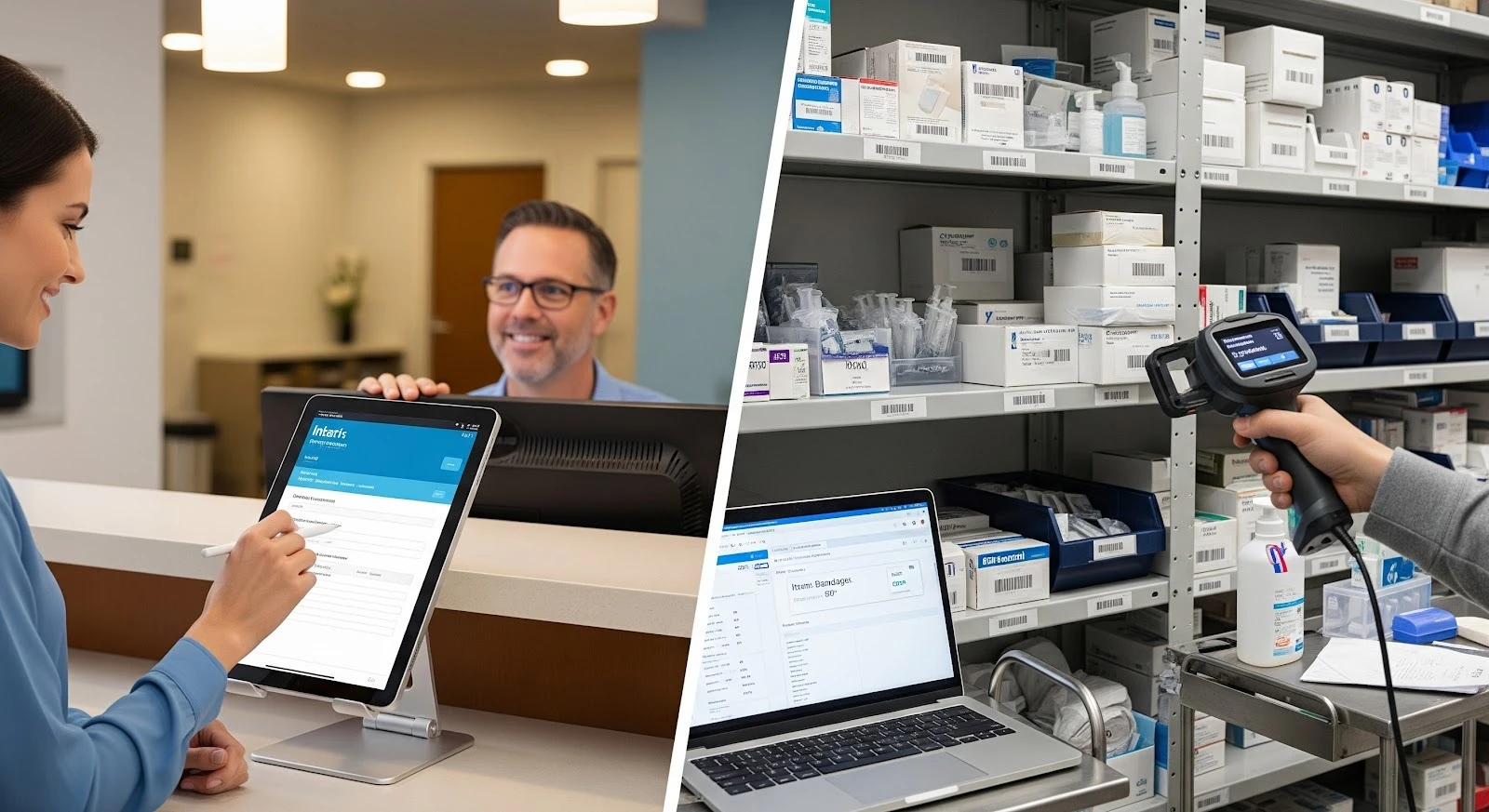
Do you continue to ask patients to complete paper forms on a clipboard when they arrive? This is a typical efficiency murderer.
To begin with, the patient must sit there and write. The receptionist must then read the handwriting (which is not always possible) and hand-type it into the computer. Lastly, the paper must be scanned or filed. It is a triple-handling nightmare.
All this changes when you move to a digital intake procedure where patients complete their history and demographics using their phone even before they enter the door. The information is automatically entered into the file. The patient is not stuck filling out paperwork, the front desk is free to actually greet people, and the clinical team already has the information they need before the consultation begins.
Likewise, check your inventory management. Do you count syringes and glove boxes manually? Automating inventory or scheduling a particular low-traffic period to check stocks will avoid the “we-are-out-of-lidocaine” panic that brings procedures to a grinding halt.
Preventing Healthcare Staff Burnout and Role Ambiguity
Lastly, a fatigued and disoriented team is the greatest efficiency killer. When roles are undefined, you have the bystander effect. No one does the task because everyone assumes someone else will take care of the referral or call for lab results. After three days, it turns into an emergency situation that collapses the entire morning.
Disengagement is caused by burnout. Fried staff work more slowly, commit more mistakes, and have no emotional capacity to effectively deal with challenging patients.
Invest in the health and clarity of your staff. Ensure that you all are aware of your “lanes.” Jane is in charge of all outgoing referrals; Mark is in charge of all incoming calls. With ownership in place, things do not slip through the cracks. And keep in mind, no team can be efficient when it is overworked. At times, you should hire that part-time administrative assistant to relieve your highly paid clinical staff so they can focus on care instead of doing paperwork.
Strategic Workflow Improvement for Medical Practices
To identify these efficiency killers, you need to take a step back and view your practice with new eyes. It involves asking why we do it this way—and being ready for the answer to be: “I do not know, we have always done it this way.”
You don’t simply process more patients by taking the friction out of your software, arranging your physical space, getting your communication in order, and acknowledging the reality of time management. You provide breathing space for your team, and your patients get the attention they need in a calm environment. Efficiency is not about haste, but about eliminating the barriers to care.